 WeightSnap
I have a weight vest that I bought when I was almost 280 pounds. I wore it on a couple walks, then stopped using it, then lost 90 pounds on retatrutide. Now it doesn't fit. It just slides around.
So I put the whole vest inside a backpack and started walking with it again. I did two walks back-to-back. Same route, same time range, same dog walking next to me. One with the backpack, one without. Garmin on both. I wanted to see how different the two walks actually were in terms of calorie burn, heart rate, and training stimulus.
The numbers were more of a gap than I expected. But more importantly, while I was going through the data I started thinking about why this specifically matters for people on GLP-1s, not just for general fitness. There are two reasons nobody talks about, and both of them are the exact reason a weighted vest might be the single highest-leverage change you can make to what you're already doing.
The setup: two walks, one variable
I've been walking daily for months. It's my main cardio. But I wanted a controlled comparison, so I did the two walks 24 hours apart, on the exact same loop near my house. Morning walks both times. Same pair of shoes. The only variable was the vest.
Walk 1 was the weighted walk. 40 pounds in the backpack, which is about 20% of my current bodyweight. Walk 2 was just walking. Both walks recorded on a Garmin watch so I'd get real data instead of eyeballing it.
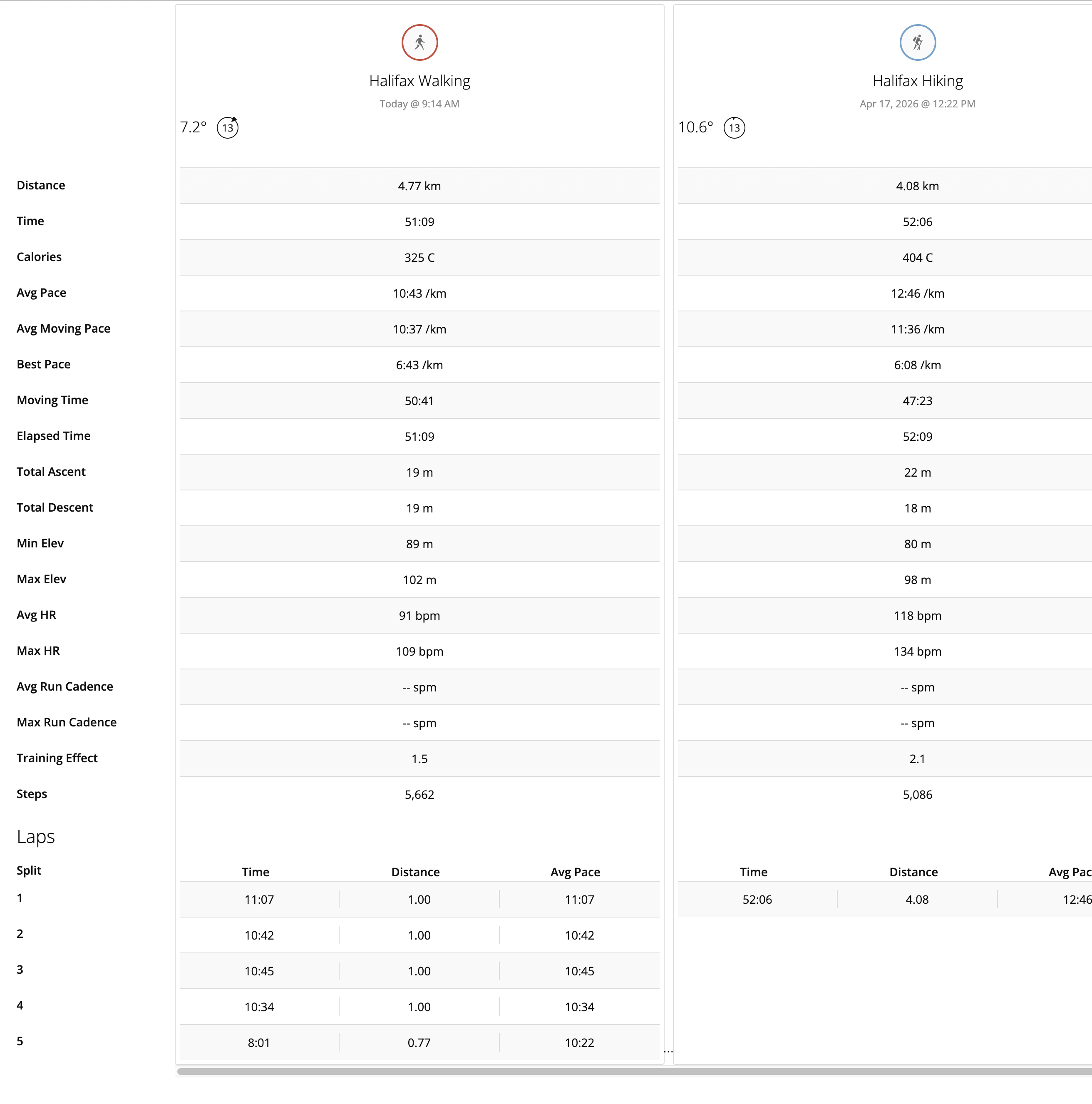
Here's what my watch captured:
The data: same 52 minutes, different workout
Let me pull out the core numbers. Both walks were about 52 minutes. Both were the same loop. Here's the side-by-side:
Here's what actually changed:
79 extra calories burned on the same 52-minute walk. If I did that daily, that's roughly 2,400 extra calories a month. About two-thirds of a pound of fat, from the exact same time I was already spending walking. No extra effort, no new routine, no extra gym session to schedule.
But the calorie number isn't even the most important one.
Why the heart rate jump matters more than the calories
91 bpm average for 52 minutes is pretty lightly elevated. For reference, my resting heart rate is around 60. So I was doing about 30 bpm over resting for the whole walk. That's light activity. Good for you, obviously. But it's not really training, it's just moving.
118 bpm average is a different story. For my zones (based on max HR testing), anything in the 111 to 138 range is Zone 2, the aerobic base zone. That's the zone longevity researchers keep talking about because it's where mitochondrial density, fat oxidation, and aerobic capacity actually improve.
The unweighted walk puts me well inside Zone 1, recovery territory. The weighted walk moves me into Zone 2 aerobic base. Same time on my feet, but now I'm actually driving cardiovascular adaptation instead of just burning off the morning coffee.
Training Effect tells the same story. Garmin's scoring system says 1.5 means "recovery / minor benefit" and 2.1 means "maintaining aerobic base." Functionally, the weighted walk is a real workout and the unweighted one is a stroll. I was making the same time investment either way. One was training. One wasn't.
Why this matters more for GLP-1 users
Here's where the story gets specific to people like us. The calorie and training-zone story applies to anyone. But there are two other things happening for GLP-1 users that most weighted-vest content doesn't touch.
1. Lean mass is quietly leaving
One of the things that's been studied pretty heavily in the GLP-1 trial data is how much of the weight people lose is actually fat vs lean mass (muscle, connective tissue, organs, water weight).
Depending on the person and the study, anywhere from 20% to 40% of total weight lost on GLP-1s can come from lean mass when no strength or loading intervention is in place. That's from the STEP and SURMOUNT trial body composition data. You see it referenced over and over in the GLP-1 research literature.
The scale moves. You look smaller. Clothes fit differently. But under the hood, some of that loss is muscle. That's the metabolic tissue that keeps your resting burn up and keeps you functional as you age. Nobody sees it on the scale, and most GLP-1 users don't find out about it until they've already plateaued and can't figure out why their body feels weaker than the weight loss should suggest.
A weighted vest doesn't solve this on its own, but it adds mechanical tension to something you're already doing. Tension is what keeps muscle on the body. You can't outrun lean mass loss with cardio, but you can slow it down with load.
2. Your bones are losing their job
This is the one almost nobody talks about.
Bones adapt to the forces placed on them. It's called Wolff's Law. Load a bone, and it remodels to handle that load. Remove the load, and the bone slowly gives back the density it doesn't need. Astronauts lose bone density in space for exactly this reason.
When you lose 90 pounds on a GLP-1, your skeleton loses 90 pounds of daily mechanical stimulus. For someone going from 280 to 190, that's about a 32% reduction in habitual skeletal loading. Combined with the rapid weight loss rate GLP-1s drive, and combined with the lean mass story above, that's a setup where bone mineral density can slip over time. Especially in post-menopausal women and anyone with existing risk factors.
The research on this is still emerging, to be clear. We don't have 20-year follow-up data on GLP-1 users. But the mechanism is well-understood, and the direction of the concern is real. Rapid weight loss + reduced loading + possible lean mass drop = a situation where something that re-loads the skeleton starts mattering.
A vest concentrates axial load on your spine, shoulders, and hips. The exact skeletal sites that matter most for osteoporosis risk. Swimming, biking, water aerobics are great cardio, but they don't load the skeleton. Walking without a vest only loads it with your current body weight (which your skeleton has already adapted to). Walking with a vest is one of the most accessible ways to re-introduce novel mechanical load to the exact bones that matter.
If you're losing weight quickly and you're not doing any resistance training or loaded walking, your bones are not getting the signal that they need to stay dense. A vest on your daily walks fixes that for maybe $60 and zero extra time.
"But I'm already overweight, aren't I already wearing a vest?"
This is the obvious objection and the one I've heard the most when I mention this to people. If you're already 100 pounds overweight, aren't you already walking around with a weight vest all day? Why would you add more?
It sounds logical. And for calorie burn alone, you're sort of right. A heavier person does burn more calories walking than a lighter person covering the same distance. But the argument falls apart when you look at the actual mechanisms. Three reasons:
1. Bone remodeling responds to novel load, not steady-state load
Your skeleton has already adapted to your current body weight. That's the new baseline. It's not novel stimulus anymore. It's the default. To drive further bone remodeling you need load above what you're already adapted to. A 40-pound vest on a 280-pound person is still 40 pounds of novel stimulus. It's additive, not redundant.
2. Distribution matters
Body fat is spread around your legs, arms, torso, and visceral and subcutaneous fat. It loads you everywhere. A weighted vest concentrates the load axially, pressing straight down through your spine, shoulders, and hips. Those are exactly the bones you care about for long-term density. The lumbar vertebrae and femoral neck are the two most clinically important sites for osteoporosis risk.
Body fat loads them some. A vest loads them more per pound, in the right direction.
3. On a GLP-1, your loading is already dropping
This is the part that flips the whole argument. If you're on a GLP-1 and actively losing weight, the mechanical stimulus on your skeleton is dropping week over week. The skeleton that was adapted to 280 is now getting less and less load every month. So "I'm already weighted" is actually less true the longer you're on a GLP-1, not more.
Adding a vest during active weight loss isn't about piling on more. It's about replacing the mechanical stimulus you're losing. You're keeping the bones and muscles working at the same load they were adapted to, while the scale keeps going down.
How to actually start (without hurting yourself)
I need to be honest here. I jumped to roughly 20% of my bodyweight on day one, because I used to wear the vest regularly and thought I'd be fine. My hip flexors hurt the next morning. I was sore for two days. Don't do what I did.
What the research actually suggests
Most studies on weighted walking land in the same ballpark. An American Council on Exercise study found that walking with a vest equal to 15% of bodyweight increased calorie burn by about 12%, and a 10% vest got roughly 13% more calories (similar effect, less load). A small Swedish study on people with mild obesity wearing an 11% bodyweight vest for 8 hours daily saw 1.4% body weight loss over 3 weeks compared to controls. The pattern across training literature is consistent: 10 to 15% of bodyweight is the sweet spot for most people doing loaded walking. That's enough to shift you into Zone 2 and drive bone and muscle stimulus without wrecking your joints or requiring serious recovery.
Above 15% is advanced territory. 20%+ is more of a military / hard-training use case. I was at 20% when I took these measurements and my hip flexors let me know it. If you're just adding a vest to your walks for GLP-1 support, you probably don't need to go past 15% of your current bodyweight long-term.
A smart ramp looks more like this:
What I use and what's actually necessary
You don't need a fancy weight vest to start. Mine was expensive at the time and now it doesn't even fit, so the joke's on me. Here's the honest breakdown:
Truly free option: rocks wrapped in towels, thrown in a backpack. Zero dollars. Walk outside, find a few decent-sized rocks, wrap each one in a towel or two so they don't dig into your back, and load them into your regular backpack. Weigh the whole thing on a bathroom scale to know what you're carrying. This is how I'd recommend anyone who's curious try it before spending a dime. Books work too, though they don't pack as densely and a big backpack of books gets bulky fast. Dumbbells wrapped in towels also work if you've got them at home.
Mid option: a decent weighted vest runs $60 to $120 on Amazon. Adjustable weights are better than fixed. You want to be able to load and unload as you progress. The vest form factor keeps the weight close to your body and centered, which is easier on your lower back than a backpack.
Overkill option: a plate carrier with ruck plates (military-style). Great gear but genuinely not necessary for what we're doing. If you want to spend more, spend it on better walking shoes first.
The best vest is the one you'll actually put on every morning. Don't overthink it. You can start today with rocks and a backpack and decide if it's for you before spending anything.
The bottom line
Here's what it comes down to. If you're on a GLP-1 and you're walking every day for exercise, you're probably doing 8,000 to 12,000 steps and calling it good. That's fine. That's not nothing. But the evidence is pretty clear that unweighted walking isn't hitting the training threshold most of us actually need. And it's definitely not loading your skeleton in the way that matters for long-term bone density.
Adding 20–40 pounds to the walk you're already taking is the single easiest, cheapest, lowest-disruption change I've found. Same time. Same route. 24% more calorie burn. A real Zone 2 workout instead of a stroll. Mechanical load on the exact bones you care about. Muscle-preserving tension on a body that's actively losing lean mass.
It's not a magic bullet. It's just the best change you can make to what you're already doing.
If you're tracking your walks, heart rate, weight, and GLP-1 doses, WeightSnap pulls it all into one view so you can see these shifts in your own data the way I saw them in mine. Free on iPhone and Android.